
Psychological Evaluation
vs Psychiatric Evaluation:
What Should You Choose?
A psychological evaluation focuses on behavior and mental processes, while a psychiatric evaluation assesses mental health conditions and medical treatment needs, a distinction clearly outlined in Psychological vs Psychiatric Evaluation Explained.
Mental health assessments provide structured insight into emotional, cognitive, and behavioral concerns. Many individuals encounter confusion when professionals recommend different assessment types. Psychological evaluation vs psychiatric evaluation often appears as a comparison point during this stage. Each assessment follows a distinct purpose and method. One focuses on behavioral patterns, thought processes, and emotional responses. The other focuses on medical diagnosis, symptom classification, and treatment direction. Research from the National Institute of Mental Health confirms structured assessments improve diagnostic accuracy and reduce delays in care. Proper assessment selection supports clarity, confidence, and continuity. Clear understanding at the beginning prevents unnecessary referrals and repeated consultations. Assessment choice directly influences therapy planning, medication decisions, and long-term outcomes.
Differences in approach and professional involvement
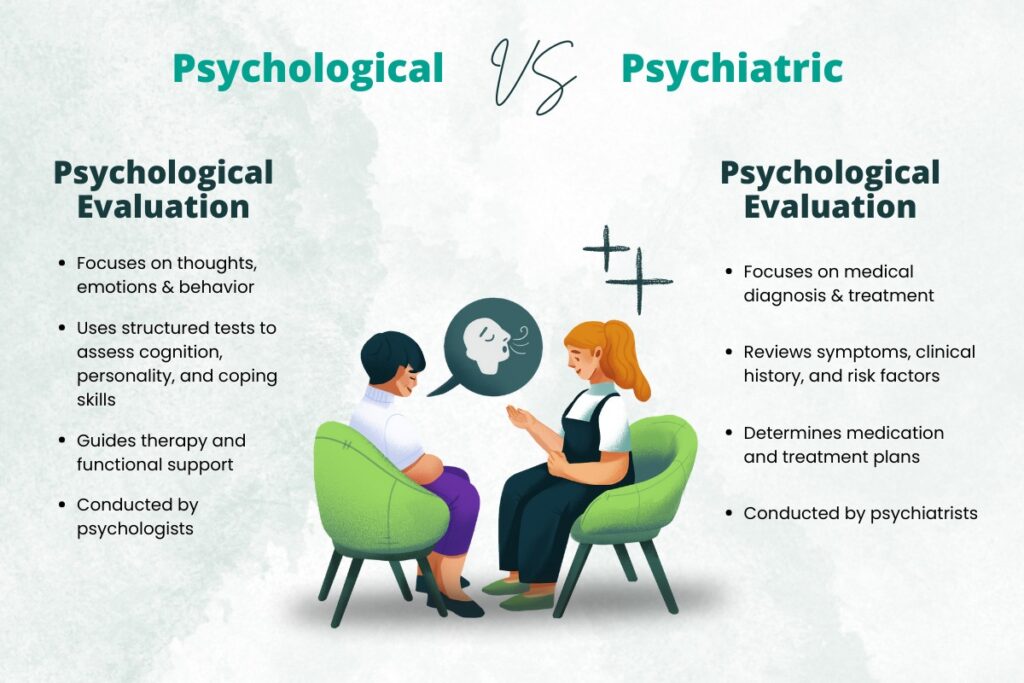
Assessment differences stem from professional training and scope. particularly within Collaborative Care Services that integrate multiple mental health disciplines. Psychologists conduct structured testing that measures cognition, personality, and emotional functioning. Psychiatrists conduct medical evaluations that focus on symptoms, clinical history, and diagnosis. Psychological evaluation vs psychiatric evaluation reflects this professional distinction. Studies published by the American Psychological Association show behavioral testing reveals patterns not captured through interviews alone. Psychiatric assessments rely on diagnostic frameworks and clinical observation. Each approach holds equal importance within mental health care. Collaboration between professionals strengthens diagnostic accuracy. Integrated care models supported by World Psychiatry research demonstrate improved treatment response when both assessment types inform care planning.
Assessment outcomes and treatment direction
Assessment outcomes vary based on evaluation type. Psychological reports provide detailed interpretations of test results and functional recommendations. Psychiatric reports provide diagnostic conclusions and treatment pathways. Psychological evaluation vs psychiatric evaluation influences how therapy, medication, and follow-up care proceed. Neuropsychological evaluation vs psychiatric evaluation adds another layer when brain behavior relationships require examination. Neurology journal findings confirm neuropsychological testing detects subtle cognitive changes earlier than interviews alone. Medical assessments address symptom severity and clinical risk. Behavioral assessments address functional capacity and coping strategies. Coordinated interpretation supports effective treatment alignment and reduces misdiagnosis rates across mental health conditions.
Importance of guidance and informed decisions
Assessment selection requires professional guidance to match presenting concerns. Many individuals search for psychological evaluation near me to access timely services and coordinated care. Local access improves follow-up and continuity, according to Health Resources data. Questions such as “Can a psychiatrist do a psychological evaluation?” arise frequently during decision- Psychiatrists conduct clinical assessments but refer standardized testing to psychologists. Collaborative referral ensures complete understanding. In some cases, genetic testing can be considered alongside Psychological evaluation vs psychiatric evaluation clarity supports informed decisions and effective care planning. For accurate direction and next steps, contact our team for professional guidance tailored to specific assessment needs.
How assessment choice influences clarity in complex cases
Complex mental health concerns often involve overlapping symptoms that require careful differentiation. Anxiety, mood disturbance, attention difficulty, and cognitive strain may appear together. Psychological evaluation vs psychiatric evaluation plays a critical role at this stage. Behavioral assessment helps clarify thought patterns, emotional regulation, and functional capacity. Medical assessment helps identify diagnostic thresholds and symptom severity. Clinical research published in Frontiers in Psychology confirms that layered assessment reduces diagnostic overlap and improves treatment precision. Misinterpretation often occurs when assessment scope does not match complexity. Proper alignment allows professionals to separate behavioral contributors from medical factors. Clear differentiation supports accurate referrals, appropriate therapy selection, and improved clinical confidence throughout the care pathway.
Why integrated assessment supports long-term stability
Long-term mental health stability depends on accurate initial assessment and informed follow-up. Psychological evaluation vs psychiatric evaluation integration supports this foundation. Behavioral data offers insight into coping capacity and adaptive skills. Medical data offers clarity on symptom progression and treatment response. Studies from the World Health Organization highlight integrated mental health models as a key factor in sustained improvement. Fragmented assessment increases the risk of partial treatment focus. Coordinated interpretation strengthens continuity of care and reduces relapse indicators. Neuropsychological evaluation vs. psychiatric evaluation collaboration further supports cases involving neurological influence. Professional coordination ensures assessment findings translate into practical, structured, and sustainable care planning.
Conclusion
Mental health clarity depends on accurate assessment and appropriate professional involvement. Psychological evaluation vs psychiatric evaluation represents two distinct but complementary approaches within mental health care. Behavioral insight supports understanding of cognition, emotion, and functional patterns. Medical assessment supports diagnosis, symptom classification, and treatment direction. Clear differentiation between assessment types reduces confusion and improves care alignment. Integrated assessment models strengthen diagnostic confidence and long-term stability. Professional guidance ensures the right evaluation at the right stage. Informed assessment selection leads to effective planning, meaningful intervention, and improved mental health outcomes across diverse clinical needs.
Both medications are valuable tools in treating anxiety, but choosing the right one depends on your symptoms, lifestyle, and long-term goals.
- Use Xanax for quick relief in severe cases, short-term.
- Choose Buspirone if you want a safer, long-term solution without sedating side effects.
Still if you not sure we’re here to help. Our team of psychiatrist’s offers personalized anxiety treatment plans. Whether it’s Buspirone, Xanax, or therapy, we tailor every plan to meet your specific needs.
Contact our clinic today to schedule your anxiety consultation.
FAQ
Frequently Asked Questions
What is the difference between psychiatric and psychological issues?
Psychiatric issues relate to medical mental health conditions. Psychological issues relate to thoughts, emotions, and behavior patterns.
Can a psychiatrist perform a psychological evaluation?
A psychiatrist completes clinical assessments. Standardized psychological testing remains the role of a psychologist.
What is the difference between a psychiatrist and a psychologist assessment?
A psychiatric assessment focuses on diagnosis and medical treatment. A psychologist assessment focuses on testing and behavioral analysis.
Is a psychological evaluation the same as a psychiatric evaluation?
A psychological evaluation and a psychiatric evaluation serve different purposes. Both support mental health care.
Is it better to be diagnosed by a psychologist or psychiatrist?
The best diagnosis depends on symptoms and needs. Coordinated assessment often provides the clearest outcome.
Learn about the conditions we treat
Recent Post

Book Your Appointment Now
Our Company
Our telehealth services allow us to provide psychiatric support and
counseling to patients across the USA with limited access. This includes
professional counseling, medication management and close monitoring to
ensure the best possible outcome.
Copyright © 2024 Safer Psychiatric Consulting Services